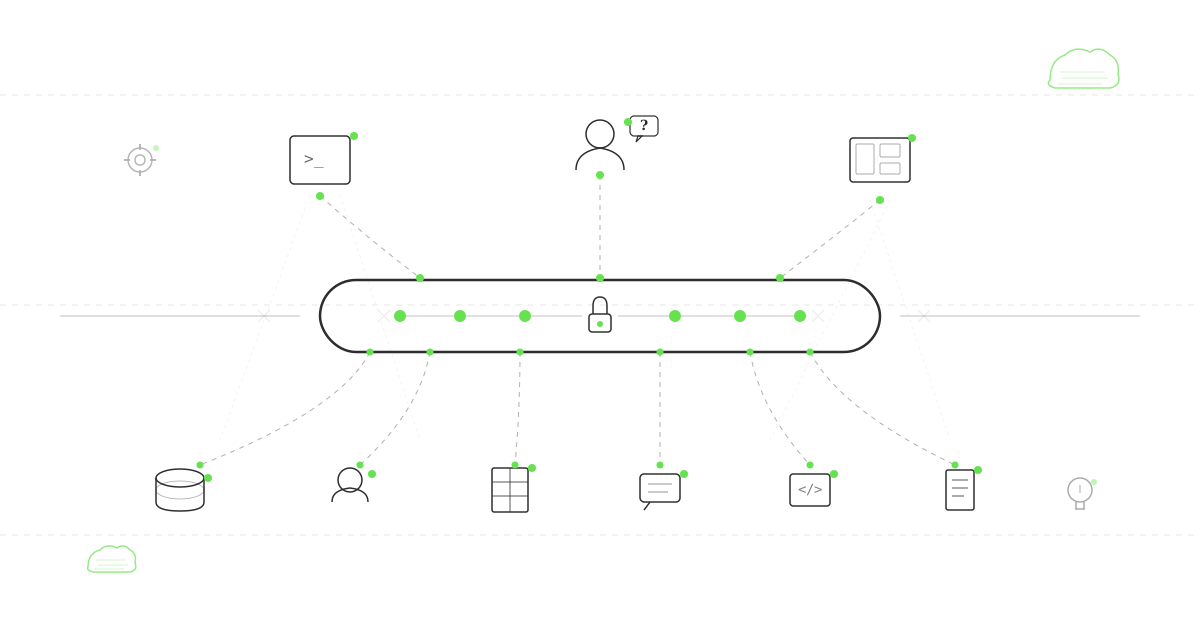
If you watched Google Marketing Live this year, you'll have heard two words on almost every slide: data strength. Google has made it one of the three things that decide whether your advertising works in the AI era, alongside causality and unified measurement. The pitch is simple. Connect more of your first-party data, feed the machine better signals, and the AI rewards you with better performance.
The numbers Google quotes are not small. Advertisers who connect offline and app data through Data Manager see an average 26% lift in incremental ROAS, by Google's own measurement. The Google tag gateway alone is credited with an average 14% conversion lift. So the instinct is obvious. Open Data Manager, switch on every connection you can find, and watch the performance climb.
Here is the problem. Data strength is not a setting. It is not a product you turn on. The connections are the easy part. The strength is in what flows through them, and that is decided long before Google ever sees your data.
What Google actually means
Strip away the branding and data strength is one question. How complete and how accurate are the first-party signals you are sending to the platforms that buy your media?
Data Manager is the front door. It pulls signals from your website, your apps, your stores and your CRM, and lines them up for Google's AI to optimise against. BigQuery, HubSpot and Shopify are all named sources. The map view shows you the pipes. The personalised guidance nudges you to connect more of them.
All of that is real and useful. But it measures whether the pipes are connected. It says nothing about whether the water is clean. You can connect every source Google offers and still be feeding the machine a weak, broken signal.
The signal is decided upstream
Think about where your conversion data is actually born. It starts with a tag firing on your site. If that tag fires client-side, an ad blocker, an ITP timer or a browser privacy setting can stop it before it ever reaches Google. You lose the event. The AI never learns from it. No connection in Data Manager can recover a signal that was never collected.
This is why server-side tagging matters more now, not less. Moving collection server-side, behind your own domain, means the signal survives the journey. It is more accurate, more durable, and it holds up as browsers keep tightening. The same is true for measurement quality across the board. Deduplicated events, properly mapped parameters, clean identifiers. None of it is glamorous. All of it decides how strong your data actually is.
This is not theory. With one of our recent clients we found roughly a quarter of all sessions on their single-page-application storefront arriving with no source attribution at all, dropped by the way the site and the consent setup interacted before they ever counted. A quarter of the data, blind. For another client, moving collection server-side with our UPDATE framework recovered 70% of previously lost sessions, and with them the attribution the business had stopped trusting. Same media spend. A far stronger signal underneath it.
Connecting strong pipes to a weak source does not give you data strength. It just gives you a more connected problem you still have.
Consent and trust are the foundation, not the tax
There is a temptation to treat consent as the thing slowing you down. The banner, the compliance review, the signals you lose when someone says no. Reframe it. Consent is what makes the signal you do collect durable.
A first-party relationship built on clear consent is a signal you own and can keep using. Consent Mode v2, configured properly so your tags actually respect the choices users make, is what keeps that signal flowing in a form the platforms will accept. Get it wrong and you are either collecting data you have no right to, or quietly losing conversions because your tags are blocked by a banner that was never set up correctly. We see the second one constantly. A banner that looks right is not the same as a consent setup that works.
The brands with the strongest data are not the ones who collect the most. They are the ones whose users trusted them enough to say yes, and whose setup honoured that yes all the way through to the platform. Trust is the moat. It is also, conveniently, the thing that makes your data strong.
The warehouse is where strength compounds
Here is where data strength stops being a media question and becomes a platform one.
The real prize is not a single conversion event pushed to Google. It is your marketing, product, customer and offline data joined together in one place you own, then governed before any of it is sent anywhere. That place is a warehouse, and for most of our clients that means BigQuery.
When your data lives in a warehouse, you decide what a conversion is. You decide which customers are worth more. You join the offline sale to the online click, the lifetime value to the lead, the refund to the original order. Then you push a considered, high-value signal to Google, rather than whatever the tag happened to catch. That is data strength as a capital asset, not a checkbox. You build it once, you own it, and every platform you connect to it gets stronger as a result.
This is the same argument we make about platforms over patches. Data strength is just the version of it that Google has now put a number against.
What this means for you
If data strength is on your roadmap because your media team or your agency raised it, the order of work matters. Do it backwards and you will connect a lot of pipes to a weak source.
A sensible sequence looks like this. Audit the signal you are actually collecting, and find out where it is leaking. Fix consent, so the data you keep is data you are allowed to keep and your tags respect it. Move collection server-side, so the signal survives modern browsers. Get the important data into a warehouse you own, so you can shape it before you send it. Then, and only then, connect it to Data Manager and let Google's AI do its work on a signal worth optimising against.
The advertisers who pull ahead in the next few years will not be the ones who switched on the most connectors. They will be the ones who built the strongest foundation underneath them. Google has handed everyone the same front door. The difference is what you have got behind it.
If you are not sure where to start, our free automated collection and consent check offers an initial view of your website setup. It is not a full audit of your tracking, consent or warehouse. For a deeper review, talk to us about a scoped assessment of the signals you collect, how your data is connected and the fixes that matter most.
The same foundations matter when you use AI to analyse the data. Katie explains the practical work in her guide to improving and testing AI answers in BigQuery.