Last week the government's coronavirus advice moved from "contain" to "delay", and Measurelab moved from "allowing" to "recommending" that we work from home. As people left the office, one at a time, I couldn't help but feeling that I was saying goodbye to people for what would probably be quite a while. It's been a week since I've seen any of my colleagues in person and while we've been trying our best to continue to foster office camaraderie remotely, it's been a bit of a learning curve for all of us.
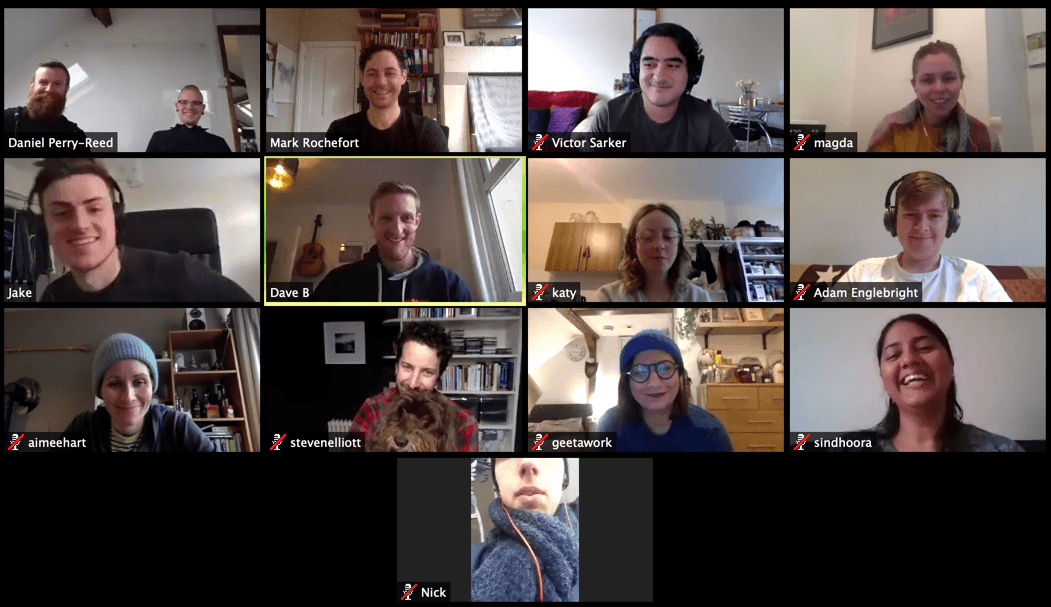
The experience of trying has taught me, amongst other things, that video-chat software isn't made equal. Before this I would've said Hangouts, Zoom, whatever; it doesn't matter what you use. I still think that's true for 2- or 3-person calls, but once you start getting a fair few people on a call, as we have been for our morning catchup calls, Zoom's gallery view makes it a lot easier to see everyone and make it feel like we're all together.
A lot of my work is stuff I can "just do", which makes things a bit easier than it has been for others—I have several colleagues whose days are chiefly composed of internal or client calls. Chaining those one into another, much as that can impact you in the office, can be even worse when you don't have the stand-up-move-around of going in and out of a meeting room, or just getting up and moving around in-between.
I've not done much working from home prior to this, so it's been a bit of an abrupt adjustment. I woke up early, and damn, I don't have my usual half-hour commute? I guess I'll… start early? And then… not stop? A lot of the usual rhythms of the working day are thrown off without familiar external cues, but I've been slowly adjusting. A lot of that has been, while embracing the newfound flexibility, enforcing or re-creating certain office-work behaviours. My colleague Dave talked about having a "shut-down ritual", closing your laptop and saying "I am done", then going for a quick walk around the block. I've also been trying to enforce breaks by making lots of cups of tea. Leaving the house at lunchtime, even if it's just going out onto the balcony and swinging my arms around, or a quick wander around the park, is really useful.
Working from home isn't like doing psychedelics in most respects, but one way it is would be the importance of set and setting. I've tried to maintain a distinction between "work mode" and "home mode" that's usually provided by a change of location. For me, it even comes down to stuff like wearing the clothes I'd normally wear to the office rather than Primark jogging bottoms I own exclusively to laze around the house in. If you're not used to working from home, as I'm not, it's easy to slip into bad habits, poor posture, etc. I've also been trying to separate my work-space physically—I'm lucky enough to have a study so as the week has gone on I've realised I'm probably better off not lounging on the sofa in the living room but rather being sat up straight in a proper chair, and so on.
As I'm finishing this up, it's Friday afternoon, and we're having a nice end-of-the-week group video chat over some beers. The vibes are good and everyone is smiling. The more we can see each others' faces and hear each others' voices the better, I think. The more we try and continue to foster that environment, the easier this will be. It's somewhat anxiety-inducing not knowing how long this is going to last, but I'm feeling more optimistic, at least right now.