It is the demo everyone has seen by now. Someone types "what was revenue last quarter, by region" into a chat box and an AI agent answers in seconds. No analyst, no dashboard, no ticket sat in a queue for a week. It looks like the future and in a sense it is.
But which definition of revenue did it use?
That question (and the answer) is the problem (and the solution) for agentic analytics.
The demo always works. Production doesn't.
Agentic analytics is the idea that an AI agent can do the analytical work, not just describe it. Interpret a question, find the data, run the query, check the result and act on it. The demos are impressive and the technology underneath them is real.
The trouble starts when you point one of these agents at your actual warehouse. A demo runs on a clean, well-labelled table where revenue means one thing. Your business does not. You have revenue, net revenue, recognised revenue and booked revenue. You have three tables that all look like they hold orders and only one that you trust. You have a column called status that six people would define six different ways.
The agent does not know any of this. So it guesses. And with a number that looks right.
A confident wrong answer is worse than no answer
A human analyst carries years of context in their head. They know the finance report excludes refunds, that marketing counts a lead differently to sales, that the table everyone queries was deprecated in 2023 and quietly stopped updating. When a question is ambiguous, a good analyst stops and asks.
An agent does not stop. It produces. Ask it a loosely worded question and it will return a precise, plausible answer built on an assumption it never told you it made. Nobody checks it, because checking it is the work the agent was supposed to save. The wrong number goes in the board pack. That is not a hypothetical. It is the default outcome of putting an agent on top of an ungoverned warehouse.
This is the part the platform vendors skate over. The model is not the hard bit. The meaning is.
The missing layer is meaning, not a bigger model
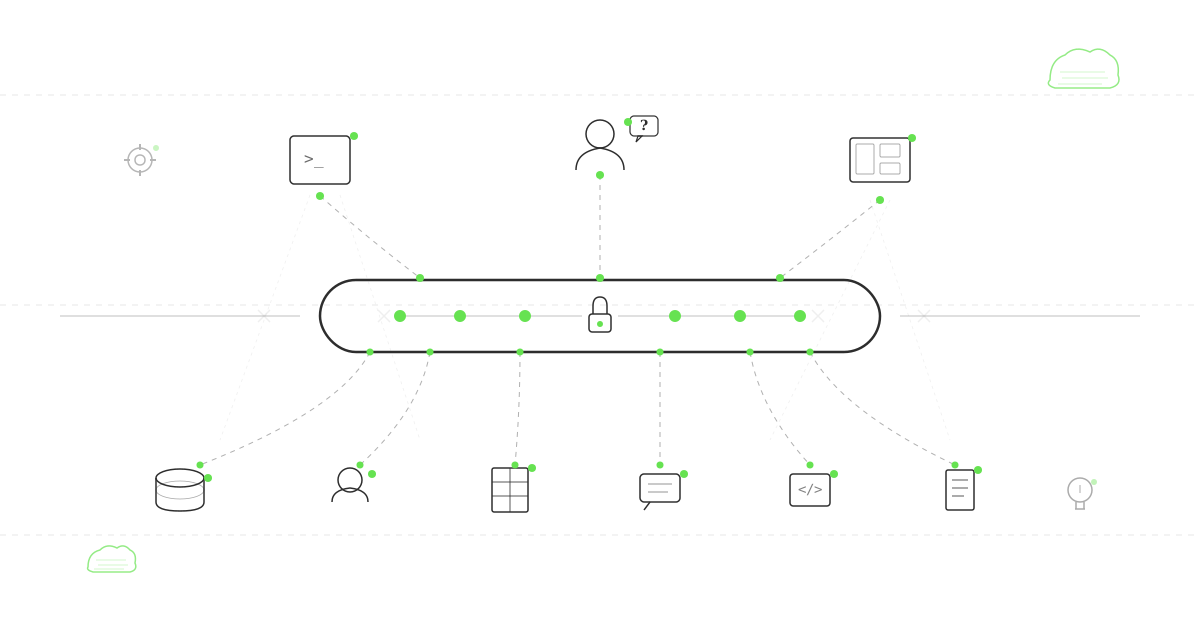
Every serious agentic-analytics architecture, once you look past the marketing, has the same thing sitting in the middle. A semantic layer. A governed set of definitions that says, in terms the agent must obey, what revenue means, what an active customer is, which table is the source of truth and how these things join together.
It is the difference between handing someone the keys to your data and handing them a map of it. Without the map, even a brilliant agent is guessing. With it, the agent stops guessing, because the meaning has already been decided by the people who actually know.
This is the unglamorous truth of agentic analytics. The breakthrough that makes it trustworthy is not a cleverer model. It is the boring, human work of agreeing what your numbers mean and writing it down in a form a machine can use.
Readiness is the work
Which is why most organisations are not ready and very few have been told so.
The data is usually there. The definitions are not, or they live in an analyst's head, a tangle of SQL and a Slack thread from last March. Getting agent-ready means doing the work that has been quietly skipped for years. Deciding what your core metrics actually mean. Governing them so they cannot drift. Exposing them to your tools through open standards, so an agent reads the same definition a human would.
That is the work we do. It is also why we built SEAM, a semantic layer that gives AI agents verified meaning instead of guesses, over the data you already have. We are not selling you another agent to add to the pile. We are building the layer that makes the agents you will adopt anyway safe to trust.
It is the same belief we have always held, pointed at a new problem. Own your foundation. Build the asset, do not rent the black box. Agentic analytics has simply raised the stakes on getting it right.
What this means for you
If someone is pitching you agentic analytics as a tool you switch on, be careful. The tool is the easy part. The readiness is the work and it is the bit that decides whether the agent helps you or quietly misleads you at scale.
A sensible order looks like this. Agree what your important metrics and entities actually mean, across teams, not just within one. Govern those definitions so they hold still. Put them in a semantic layer your tools can read. Then let the agents loose, knowing that when they answer, they are answering with your meaning, not their best guess.
The organisations that win with agentic analytics will not be the ones who bought the cleverest agent. They will be the ones who did the boring work first. In our own benchmark, an agent governed through a semantic layer answered entity-routing questions correctly every time; the ungoverned baseline managed half (see the SEAM vs direct stats). The agent is the easy part. The meaning underneath it is your moat.
If you want to know whether your data is ready for the agents heading your way, we run a short readiness assessment: we look at your core metrics, where they are defined and where they drift and you get back a prioritised picture of what to fix first. Start with what your numbers mean. Everything else follows from there.
Update — September 2026: SEAM continues to evolve as an approach to shared meaning and context for people and AI. The runtime described in this article was an earlier implementation of that concept.